Monday, May 9, 2016

[48] Surah Al-Fath [The Victory]: Ayat 015


১৫. তোমরা যখন যুদ্ধলব্ধ ধন-সম্পদ সংগ্রহের জন্য যাবে, তখন যারা পশ্চাতে থেকে গিয়েছিল, তারা বলবেঃ আমাদেরকেও তোমাদের সঙ্গে যেতে দাও।  তারা আল্লাহর কালাম পরিবর্তন করতে চায়বলুনঃ তোমরা কখনও আমাদের সঙ্গে যেতে পারবে না আল্লাহ পূর্ব থেকেই এরূপ বলে দিয়েছেনতারা বলবেঃ বরং তোমরা আমাদের প্রতি বিদ্বেষ পোষণ করছপরন্তু তারা সামান্যই বোঝে

Ayat 15. Those who lagged behind will say, when you set forth to take the spoils, "Allow us to follow you," They want to change Allah’s Words. Say: "You shall not follow us; thus Allah has said beforehand." Then they will say: "Nay, you envy us." Nay, but they understand not except a little.

Tafseer of Surah Al-Fath Ayat 15. Those who lagged behind(4883) (will say), when ye (are free to) march and take booty (in war): "Permit us to follow you." They wish to change Allah’s decree: Say: "Not thus(4884) will ye follow us: Allah has already declared(4885) (this) beforehand": then they will say, "But ye are(4886) jealous of us." Nay, but little do they understand (such things). 4883 Now comes out another motive behind the minds of the laggards. The journey for pilgrimage had no promise of war booty. If at any future time there should be a promise of booty they would come! But that is to reverse Allah's law and decree. Jihad is not for personal gain or booty: see S. 8 and Introduction to S. 8, paragraph 2. On the contrary Jihad is hard striving, in war and peace, in the Cause of Allah. 4884 Not thus: i.e., not on those terms; not if your object is only to gain booty. 4885 See 8:1, and n. 1179. 4886 The desert Arabs loved fighting and plunder, and understood such motives for war. The higher motives seemed to be beyond them. Like ignorant men they attributed petty motives or motives of jealousy if they were kept out of the vulgar circle of fighting for plunder. But they had to be schooled, and they were schooled to higher ideas of discipline, self-sacrifice, and striving hard for a Cause. 

Hazrat Ibn Masud (May Allah be pleased with him) reported: After the battle of Hunain, Messenger of Allah image001.jpg [SAWW](PBUH) favored some people in the distribution of spoils (for consolation). He gave Al-Aqra bin Habis and Uyainah bin Hisn a hundred camels each and showed favor also to some more honorable persons among the Arabs. Someone said: "This division is not based on justice and it was not intended to win the Pleasure of Allah.'' I said to myself: "By Allah! I will inform Messenger of Allah image001.jpg [SAWW](PBUH) of this.'' I went to him and informed him. His face became red and he said, "Who will do justice if Allah and His Messenger do not?'' Then he said, "May Allah have mercy on (Prophet) Musa (Moses)[A.S]; he was caused more distress than this but he remained patient.'' Having heard this I said to myself: "I shall never convey anything of this kind to him in future".
[Al-Bukhari Book 04, Chapter 53, Hadith # 378]

Lesson: as mentioned above in Surah Al-Fath Ayat 15. Those who lagged behind will say, when you set forth to take the spoils” This Hadith leads to the conclusion that the leader of the people or the Caliph has a right, if situation demands, to give to the new Muslims and other influential and respectable people of the society more than others for their satisfaction and encouragement. The man who raised objection on the distribution of booty by the Prophet image001.jpg [SAWW](PBUH) was a hypocrite. Devout Muslims could never think that the Prophet image001.jpg [SAWW](PBUH) could be unjust to anyone. This incident also goes to prove that the Prophet image001.jpg [SAWW](PBUH) also felt as much as others did, the things which infuriated or pleased others, because he was a man and not a superhuman being. 

[48] Surah Al-Fath [The Victory]: Ayat 013-014


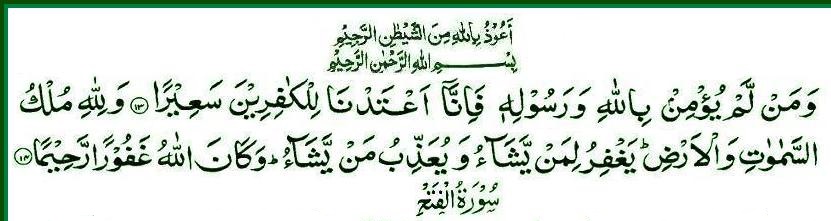
১৩. যারা আল্লাহ ও তাঁর রসূলে বিশ্বাস করে না, আমি সেসব কাফেরের জন্যে জ্বলন্ত অগ্নি প্রস্তুত রেখেছি
১৪. নভোমন্ডল ও ভূমন্ডলের রাজত্ব আল্লাহরইতিনি যাকে ইচ্ছা ক্ষমা করেন এবং যাকে ইচ্ছা শাস্তি দেনতিনি ক্ষমাশীল, পরম মেহেরবান 

Ayat. 13. And whosoever does not believe in Allah and His Messenger (Muhammad image001.jpg [SAWW](PBUH), then verily, We have prepared for the disbelievers a blazing Fire.
Ayat 14. And to Allah belongs the sovereignty of the heavens and the earth, He forgives whom He wills, and punishes whom He wills. And Allah is Ever Oft-Forgiving, Most Merciful.

Tafseer of Surah Al-Fath Ayat 13 and 14. And if any believe not in Allah and His Messenger, We have prepared, for those who reject Allah, a Blazing Fire! 14. To Allah belongs the dominion of the heavens and the earth: He forgives whom He wills, and He punishes whom He wills: but Allah is Oft-Forgiving, Most Merciful. 4882 Evil must inevitably have its punishment, but there is one way of escape, viz., through repentance and the Mercy of Allah. Allah's Justice will punish, but Allah's Mercy will forgive; and the Mercy is the predominant feature in Allah's universe: "He is Oft-Forgiving, Most Merciful." 

Hazrat Abdullah bin Amr bin Al-Aas (May Allah be pleased with him) reported: The Messenger of Allah image001.jpg [SAWW](PBUH) said, "Four are the qualities which, when found in a person, make him a sheer hypocrite, and one who possesses one of them, possesses one characteristic of hypocrisy until he abandons it. These are: When he is entrusted with something, he betrays trust; when he speaks, he lies; when he promises, he acts treacherously; and when he argues, he behaves in a very imprudent, insulting manner.''
[Al-Bukhari 01, Chapter 02, Hadith # 033].

Lesson: as mentioned above in Surah Al-Fath Ayat 13. And whosoever does not believe in Allah and His Messenger (Muhammad image001.jpg [SAWW](PBUH), then verily, We have prepared for the disbelievers a blazing Fire. 
Theologically speaking, a disagreement between heart and tongue - or word and deed - about the declaration of faith in Islam is defined as hypocrisy. In the lifetime of the Prophet image001.jpg [SAWW](PBUH) there existed a group of hypocrites whose traits of characters have been outlined in Ahadith. Humanly it is not possible to perceive malice hidden in one's heart. Even Messenger of Allah image001.jpg [SAWW](PBUH) hardly knew what lay in the hearts of people because, despite having the exalted status of Prophet Hood, he was fundamentally a human. Allah, however, had revealed hearts to him. But today, we have no error-free source to pick hypocrites from the ranks of believers. Quite naturally, we fall back on the Hadith which provides us definite symptoms of the character and manners of hypocrites so as to distinguish them from sincere Muslims. Ulama' say that there are two aspects of hypocrisy, relating to faith and practice. In the first case, a hypocrite conceals his disbelief in his heart but verbally professes Islam. Anyone who belongs to this category of hypocrites will be, as stated in the Qur'an: "In the lowest depths of the Fire.'' (4:145). in the second case, a man does have faith in his heart but in practice he portrays the characteristics of a hypocrite, unfortunately a majority of today's Muslims practically behave like hypocrites and possess their propensities. It is this hypocritical attitude and moral deficiencies of Muslims that have degraded them and made Islam unappealing. May Allah put Muslims on the right path! 

[48] Surah Al-Fath [The Victory]: Ayat 012


১২. বরং তোমরা ধারণা করেছিলে যে, রসূল ও মুমিনগণ তাদের বাড়ী-ঘরে কিছুতেই ফিরে আসতে পারবে না এবং এই ধারণা তোমাদের জন্যে খুবই সুখকর ছিল।  তোমরা মন্দ ধারণার বশবর্তী হয়েছিলে তোমরা ছিলে ধ্বংসমুখী এক সম্প্রদায়

Ayat 12. "Nay, but you thought that the Messenger (image001.jpg [SAWW](PBUH) and the believers would never return to their families; and that was made fair-seeming in their hearts, and you did think an evil thought and you became a useless people going for destruction."

Tafseer of Surah Al-Fath Ayat 12. "Nay, ye thought that the Messenger and the Believers would never return to their families; this seemed pleasing in your hearts, and ye conceived an evil thought, for ye are a people lost (in wickedness)." Their faith was so shaky that they thought the worst would happen, and that the Makkan Quraysh would destroy the unarmed band. In their heart of hearts they would not have been sorry, because they were steeped in wickedness and rejoiced in the sufferings of others. But such persons will burn in the fire of their own disappointment. 

Hazrat Abu Hurairah (May Allah be pleased with him) reported: The Messenger of Allahimage001.jpg [SAWW](PBUH) said,  "Seek refuge in Allah against the turmoil’s, attacks of misfortunes, and evil of judgment and joys of the enemies.''
[Al-Bukhari Book 8, Chapter 75, Hadith # 358]

Lesson: as mentioned above in Surah Al-Fath Ayat 12. “that was made fair-seeming in their hearts, and you did think an evil thought and you became a useless people going for destruction" The trouble of a trial which is unbearable for a person and from which he does not have the power to rid himself is called (juhd al-bala'), translated here as `turmoil’s'. Some people are of the opinion that it is synonymous with poverty combined with abundant children. But Al-Hafiz Ibn Hajar is of the view that it is only one of the several kinds of "Troubles of a Trial.'' "Ash-Shaqa' is the opposite of good fortune, that is, to pray for protection from misfortune. No Decision of Allah is wrong but some of His Decisions may be harmful for certain people while others are beneficial for them. This means that their goodness or badness is related to persons. What it signifies is that one should pray to Allah to keep one safe from such decisions which are harmful for him. "Shamatat'' the pleasure that one's enemy feels on one's trouble. In other words, it is prayed that Allah may protect one from any such trouble which is pleasing to one's enemy, because when a person is in trouble, his enemies feel pleasure over it. In this Hadith, one sentence was added by Abu Sufyan and during his old age he did not remember which one it was. But we learn from other Ahadith that it was "the pleasure of enemies''. (Ibn Allan). This Hadith also shows the honesty and integrity of the narrators of Ahadith. They were honest to the extent that if a few words of supplication were added to a Hadith by its narrators, they would point it out. Some scholars have regarded these words an addition in the Hadith by its narrator, who is otherwise reliable, but it is not a problem of "addition of authority'' because in that case, the addition is the saying of the Prophet (PBUH) which is mentioned by one narrator and omitted by another. But here it is quite different as the narrator of the Hadith himself is pointing out the addition made by him. Such additional words are technically called "Mudraj''

Thursday, May 5, 2016

[48] Surah Al-Fath [The Victory]: Ayat 011


১১. মরুবাসীদের মধ্যে যারা গৃহে বসে রয়েছে, তারা আপনাকে বলবেঃ আমরা আমাদের ধন-সম্পদ ও পরিবার-পরিজনের কাজে ব্যস্ত ছিলাম অতএব, আমাদের পাপ মার্জনা করানতারা মুখে এমন কথা বলবে, যা তাদের অন্তরে নেইবলুনঃ আল্লাহ তোমাদের ক্ষতি অথবা উপকার সাধনের ইচ্ছা করলে কে তাকে বিরত রাখতে পারে? বরং তোমরা যা কর, আল্লাহ সে বিষয় পরিপূর্ণ জ্ঞাত

Ayat. 11. Those of the Bedouins who lagged behind will say to you: "Our possessions and our families occupied us, so ask forgiveness for us." They say with their tongues what is not in their hearts. Say: "Who then has any power at all (to intervene) on your behalf with Allah, if He intends you hurt or intends you benefit? Nay, but Allah is Ever All-Aware of what you do. Tafseer of Surah 

Al-Fath Ayat 11. The desert Arabs who lagged behind will say to thee: "We were engaged in (looking after) our flocks and herds, and our families: do thou then ask forgiveness for us.”They say with their tongues what is not in their hearts. Say: "Who then has any power at all (to intervene) on your behalf with Allah, if His Will is to give you some loss or to give you some profit? But Allah is well acquainted with all that ye do. When the Prophet started from Madinah on the Makkah journey which ended in Hudaibiyyah, he asked all Muslims to join him in the pious undertaking, and he had a splendid response. But some of the desert tribes hung back and made excuses. Their faith was but lukewarm, and they did not want to share in any trouble which the Makkans might give to the unarmed Muslims on pilgrimage. Their excuse that they were engaged in looking after their flocks and herds and their families was an afterthought, and in any case made after the return of the Prophet and his party with enhanced prestige to Madinah. They said this with their tongues, but no thought of piety was in their hearts. Their false excuse was based on a calculation of worldly profit and loss. But what about the spiritual loss in detaching themselves from the Prophet or spiritual profit in joining in the splendidly loyal feelings of service and obedience which were demonstrated at Hudaibiyyah? And in any case they need not think that all their real and secret motives were not known to Allah. 

Hazrat Ibn Masud (May Allah be pleased with him) reported: He who likes to meet Allah tomorrow (i.e., on the Day of Requital) as a Muslim, should take care and observe the Salat when the Adhan is announced for them. Allah has expounded to your Prophet cid:image004.gif@01D1A520.31E0AF00[SAWW](PBUH) the ways of right guidance, and these (the prayers) are part of the right guidance. If you have to perform Salat in your houses, as this man who stays away (from the mosque) and performs Salat in his house, you will abandon the Sunnah (practice) of your Prophet (PBUH), and the departure from the Sunnah of your Prophet cid:image004.gif@01D1A520.31E0AF00[SAWW](PBUH) will lead you astray. I have seen the time when no one stayed behind except a well-known hypocrite. I also saw that a man was brought swaying (on account of weakness) between two men till he was set up in a row (in the masjid).  [Muslim Book 04, chapter 85, Hadith # 1376].

Lesson : as mentioned above in Lesson: as mentioned above in Surah Al-Fath Ayat 11.” ." They say with their tongues what is not in their hearts” This Hadith makes the following four points:
1.Emphasis on performing Salat in congregation means (Iqamat-as-Salat),.
2.The passion of the Companions of the Prophet cid:image004.gif@01D1A520.31E0AF00[SAWW](PBUH) for Salat.
3.Evasion from Salat with congregation is a practice of hypocrites.
4.Inducement for following the Sunnah of the Prophet cid:image004.gif@01D1A520.31E0AF00[SAWW](PBUH) because evasion from it is bound to lead one astray.

Tuesday, May 3, 2016

[48] Surah Al-Fath [The Victory]: Ayat 010


১০. যারা আপনার কাছে আনুগত্যের শপথ করে, তারা তো আল্লাহর কাছে আনুগত্যের শপথ করে আল্লাহর হাত তাদের হাতের উপর রয়েছেঅতএব, যে শপথ ভঙ্গ করে; অতি অবশ্যই সে তা নিজের ক্ষতির জন্যেই করে এবং যে আল্লাহর সাথে কৃত অঙ্গীকার পূর্ণ করে; আল্লাহ সত্ত্বরই তাকে মহাপুরস্কার দান করবেন

Ayat 10. Verily, those who give Bai'a (pledge) to you (O Muhammad image001.jpg [SAWW](PBUH) they are giving Bai'a (pledge) to Allah. The Hand of Allah is over their hands. Then whosoever breaks his pledge, breaks only to his own harm, and whosoever fulfills what he has covenanted with Allah, He will bestow on him a great reward.

Tafseer of Surah Al-Fath Ayat 10. Verily those who plight their fealty to thee do no less than plight their fealty to Allah. The Hand of Allah is over their hands: then anyone who violates his oath, does so to the harm of his own soul, and anyone who fulfils what he has covenanted with Allah,- Allah will soon grant him a great Reward. In the Hudaibiyyah negotiations, when it was uncertain whether Quraysh would treat well or ill the Prophet's delegate to Makkah, there was a great wave of feeling in the Muslim camp of 1400 to 1500 men. They came with great enthusiasm and swore their fealty to the Prophet, by placing hand on hand according the Arab custom: see paragraph 3 of the Introduction to this Surah. This in itself was wonderful demonstration of moral and material strength, a true Victory; it is called Bay ‘at Al-Ridwan (Fealty of Allah's Good Pleasure) in Islamic History. They placed their hands on the Prophet's hand, but the Hand of Allah was above them, and He accepted their Fealty. 

Hazrat Abu Abdur Rehman Auf bin Malik Al-Ashjai (May Allah be pleased with him) reported: Seven, eight or nine people, including myself, were with Messenger of Allah cid:image004.gif@01D1A495.E4D239C0[SAWW](PBUH) on an occasion when he cid:image004.gif@01D1A495.E4D239C0[SAWW](PBUH) remarked, "Would you pledge allegiance to Messenger of Allah?'' As we had taken oath of allegiance shortly before, we said, "We have already done so, O Messenger of Allah.'' He again asked, "Would you not pledge allegiance to Messenger of Allah?'' So we stretched out our hands and said, "We have already made our pledge with you, O Messenger of Allah, on what should we make a pledge with you?'' He said, "To worship Allah and not to associate anything with Him, to perform the five (daily) Salat and to obey.'' Then he added in a low tone, "And not to ask people for anything.'' Thereafter, I noticed that some of these people who were present did not ask anyone to pick up anything for them if it fell from their hands.
[Muslim Book 05, Chapter 33, Hadith # 2270]

Lesson: as mentioned above in Surah Al-Fath Ayat 10. Verily, those who give Bai'a (pledge) to you (O Muhammad image001.jpg [SAWW](PBUH) they are giving Bai'a (pledge) to Allah" Herein we find an approval of renewing the oath of loyalty; besides, there is also a ground for administering such oath in respect of the obedience and worship of Allah, and decent behavior. What is more, we are also under obligation to observe all that the oath of fealty stands for.

[48] Surah Al-Fath [The Victory]: Ayat 008-009


৮. আমি আপনাকে প্রেরণ করেছি অবস্থা ব্যক্তকারীরূপে, সুসংবাদদাতা ও ভয় প্রদর্শনকারীরূপে
৯. যাতে তোমরা আল্লাহ ও রসূলের প্রতি বিশ্বাস স্থাপন কর এবং তাঁকে সাহায্য ও সম্মান কর এবং সকাল-সন্ধ্যায় আল্লাহর পবিত্রতা ঘোষণা কর

Ayat. 8. Verily, We have sent you (O Muhammad image001.jpg [SAWW](PBUH)) as a witness, as a bearer of glad tidings, and as a warner.
Ayat 9. In order that you (O mankind) may believe in Allah and His Messenger (image001.jpg [SAWW](PBUH), and that you assist and honor him, and (that you) glorify (Allah’s) praises morning and afternoon.

Tafseer of Surah Al-Fath Ayat 8 and 9. We have truly sent thee as a witness, as a bringer of Glad Tidings, and as a Warner: The Prophet came in order to establish Faith in Allah and true worship. We can view him in three capacities: (1) as a witness to help the weak if they were oppressed and check the strong if they did wrong; (2) as a giver of the Glad Tidings of Allah's Grace and Mercy to those who repented and lived good lives; and (3) as one who warned sinners of the consequences of their sin. Ayat 9. In order that ye (O men) may believe in Allah and His Messenger, that ye may assist and honor Him, and celebrate His praise morning and evening. Assist and honor Him: most commentators agree that the pronoun 'Him' refers to Allah, while a few believe it refers to the Prophet. 

Hazrat Abdullah bin Abbas (May Allah be pleased with him) reported: The Messenger of Allah image001.jpg [SAWW](PBUH) used to supplicate: "O Allah! To You I have submitted, and in You do I believe, and in You I put my trust, to You do I turn, and for You I argued. O Allah, I seek refuge with You through Your Power; there is none worthy of worship except You Alone; that You safeguard me against going astray. You are the Ever Living, the One Who sustains and protects all that exists; the One Who never dies, whereas human beings and jinn will all die".  [Muslim Book 35, Chapter 17, Hadith # 6561].

Lesson: as mentioned above in Surah Al-Fath Ayat 09 “In order that you (O mankind) may believe in Allah and His Messenger (image001.jpg [SAWW](PBUH), and that you assist and honor him, and (that you) glorify (Allah’s) This Hadith mentions the importance of Dua and faith in Allah, inducement for having trust in Him and the distinction of people who have these qualities.

[48] Surah Al-Fath [The Victory]: Ayat 006-007


৬. এবং যাতে তিনি কপট বিশ্বাসী পুরুষ ও কপট বিশ্বাসিনী নারী এবং অংশীবাদী পুরুষ ও অংশীবাদিনী নারীদেরকে শাস্তি দেন, যারা আল্লাহ সম্পর্কে মন্দ ধারণা পোষন করে।  তাদের জন্য মন্দ পরিনামআল্লাহ তাদের প্রতি ক্রুদ্ধ হয়েছেন, তাদেরকে অভিশপ্ত করেছেন এবং তাহাদের জন্যে জাহান্নাম প্রস্তুত রেখেছেনতাদের প্রত্যাবর্তন স্থল অত্যন্ত মন্দ
৭. নভোমন্ডল ও ভূমন্ডলের বাহিনীসমূহ আল্লাহরই।  আল্লাহ পরাক্রমশালী, প্রজ্ঞাময়

Ayat. 6. And that He may punish the Munafiqun (hypocrites), men and women, and also the Mushrikun men and women, who think evil thoughts about Allah, for them is a disgraceful torment, and the Anger of Allah is upon them, and He has cursed them and prepared Hell for them, and worst indeed is that destination.
Ayat 7. And to Allah belong the hosts of the heavens and the earth. And Allah is Ever All-Knower, All-Wise.

Tafseer of Surah Al-Fath Ayat 6 and 7. And that He may punish the Hypocrites, men and women, and the Polytheists men and women, who imagine an evil opinion of Allah. On them is a round of Evil: the Wrath of Allah is on them: He has cursed them and got Hell ready for them: and evil is it for a destination. They will be encircled (or hemmed in) by Evil. That is, deprived them of His Grace, on account of their continued rejection of it. Ayat 7. For to Allah belong the Forces of the heavens and the earth; and Allah is Exalted in Power, Full of Wisdom. These words are repeated (with a slight change) from the parenthetical clause in verse 4, to emphasize the assertion as a substantive proposition, that fighting and visible forces in the physical world are not the only forces with which Allah works out His Plan. The invisible forces are more important as they were at Hudaibiyyah. The slight difference is instructive; in the parenthetical clause, Allah's Knowledge was emphasized, and in the substantive clause it is Allah's Power. Knowledge plans, and Power executes. 

Hazrat Abu Hurairah (May Allah be pleased with him) reported: The Messenger of Allahimage001.jpg [SAWW](PBUH) said,  "There are two types of people who will be punished in Hell and whom I have not seen (as they are not born yet): men having (very long) whips like the tails of cows and they will be beating people with them, and, women who will be dressed but appear to be naked, inviting to evil; and they themselves will be inclined to it. Their heads will appear like the humps of the Bactrian camel inclined to one side (like hair style of collection hair on top of their head like Bactrian Camel). They will not enter Jannah and they will not smell its fragrance which is perceptible from such and such distance.'' [Muslim Hadith # 5310].

Lesson: as mentioned above in Surah Al-Fath Ayat 6. And that He may punish the Munafiqun (hypocrites), men and women, and also the Mushrikun men and women. This Hadith has the following three important points: 1. It has a warning for those who oppress people. Flogging in Hadd and Qisas does not come in the category of oppression because oppression in the real sense is perpetrated when whipping is done as a means of tyranny and cruelty. 2. It has a stern warning for those women who go about without wearing the Islamic-type veil and take to adornment to display their charms, which is the habit of immoral women. Such women also adorn their hair in different styles and lure men with their coquetry and amorous playfulness. They are shameless and also make others likewise, shameless. 3. This Hadith is one of the signs of the Prophethood of Muhammad [SAWW](PBUH), the last of the Prophets of Allah, because the evils which he had prophesied in this Hadith have been fulfilled. Muslim women have adopted all these evils and shameless fashions without any fear of punishment in the Hereafter. May Allah relieve us from these evils.